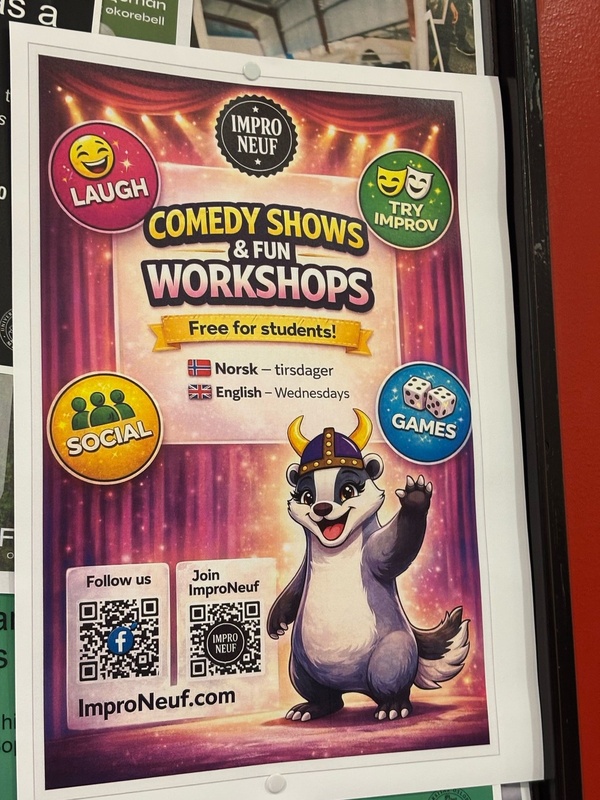
Poster advertising free comedy shows and improv workshops for students. Poster includes an image of a squirrel wearing a horned helmet. More information here: https://improneuf.com/dt/web/.
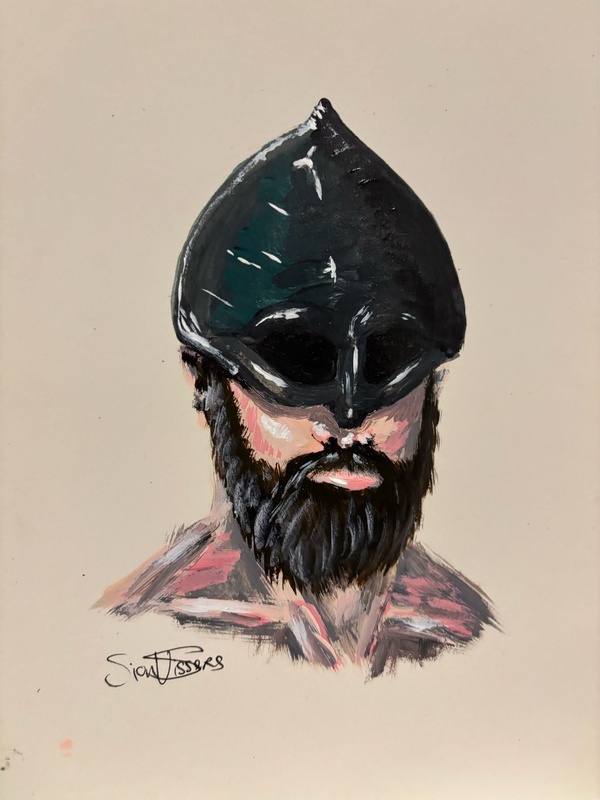
The portrait depicts a bearded man wearing a dark possibly Gjermundbu-style helmet featuring a distinctive prominent brow and eye-guard mask. Artwork is an original painting, and also signed by, by Sion Vissers.
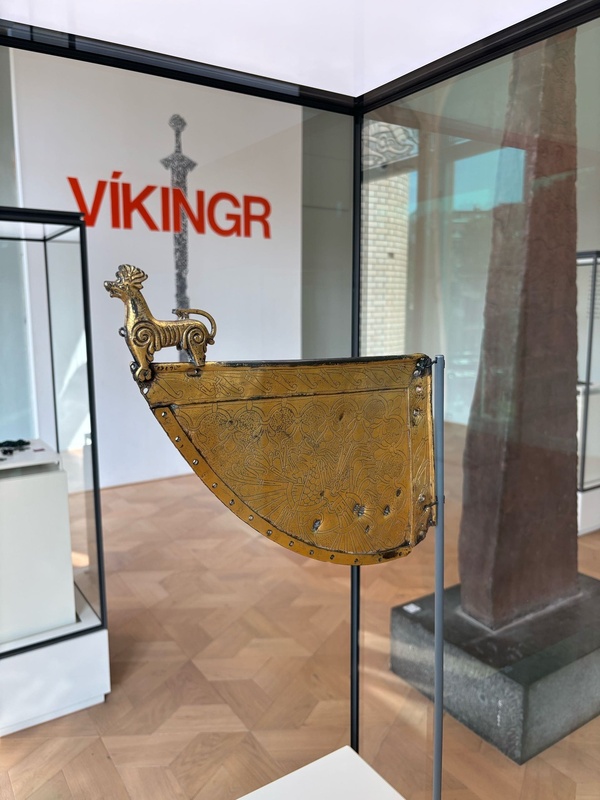
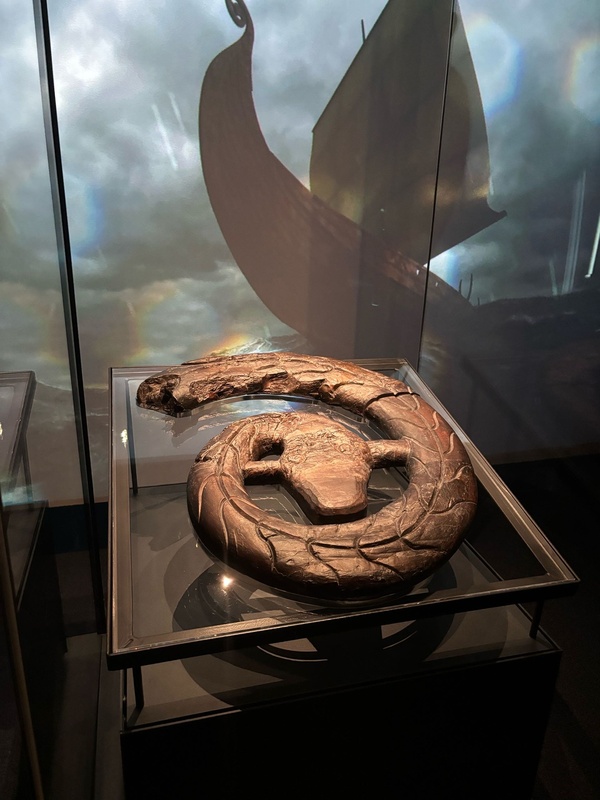
The Heggen weather vane, also known as Heggenfløyen, is a gilded copper alloy weather vane dating back to around 1050 CE. Originally mounted on a Viking longship, it was later placed atop the spire of the Heggen church in Norway. The vane features intricate engravings depicting battles between real and fantastical beasts, showcasing the Ringerike style of Norse art. It is now on display at the Museum of Cultural History in Oslo.
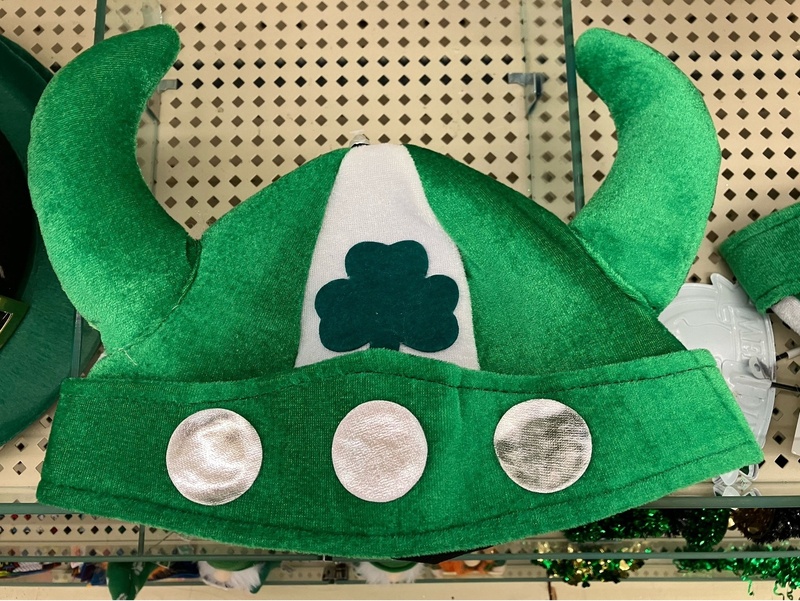
Green and white velvet Shamrock Viking hat which features horns, a white center panel with a dark green shamrock, and silver circular accents along the brim.
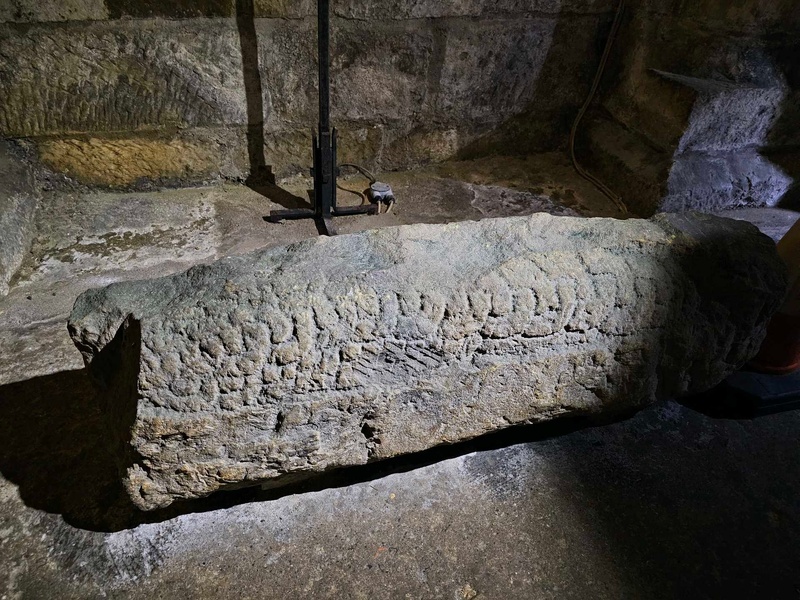
Tenth-century Anglo-Scandinavian hogback stone featuring a carving of a bear and displayed in the crypt in St Mary's Church, Lastingham (England). Hogbacks are house-shaped grave markers particular to Norse areas of settlement in the north of England and southern Scotland.
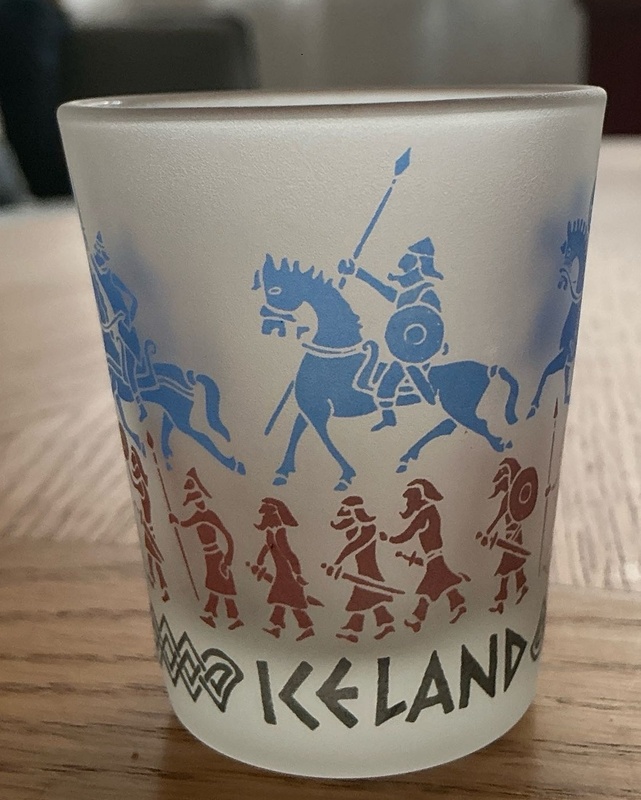
Frosted shot glass with patterns including Vikings on horses and warrior Vikings holding shields, swords and spears. Inscription says "Iceland" with a runic inspired print and pattern.
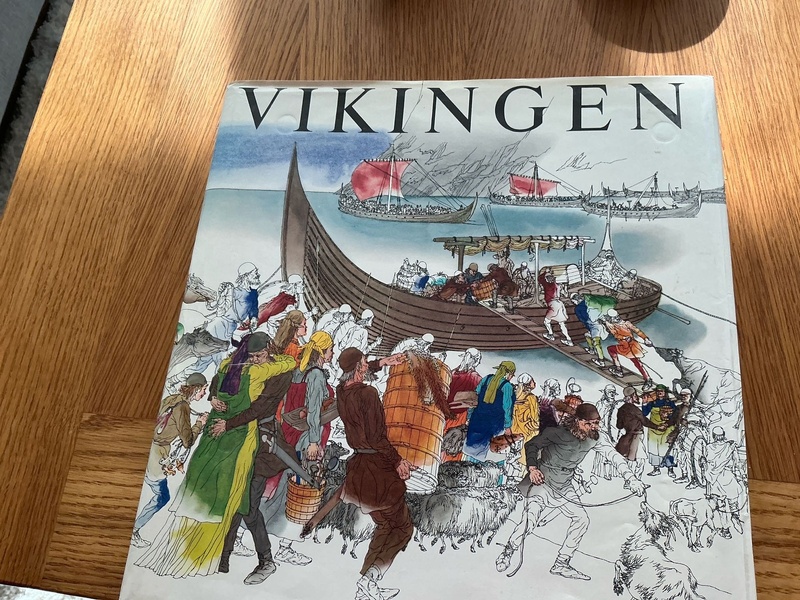
"Vikingen" (The Viking)- book providing a comprehensive look at Viking history, culture, and daily life. Author / Chief Contributor: Bertil Almgren (along with an international team of Scandinavian and English scholars)
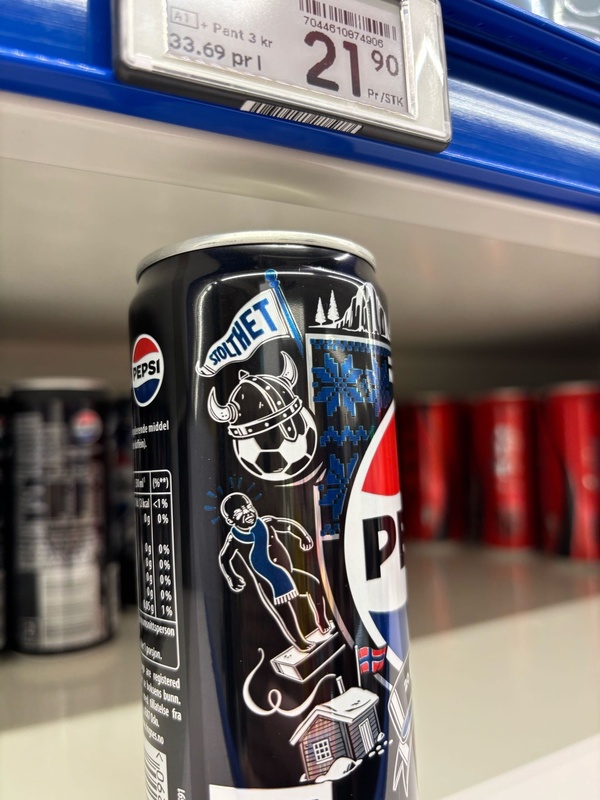
A can of Pepsi from Norway, with typical Norwegian motifs based around the theme "stolthet" (pride) made for the World cup: a fotball with a horned viking helmet, Vigeland's The Angry Boy wearing a football scarf, a cabin with the Norwegian flag on its roof, mountains, a forest, and the Selburose pattern.
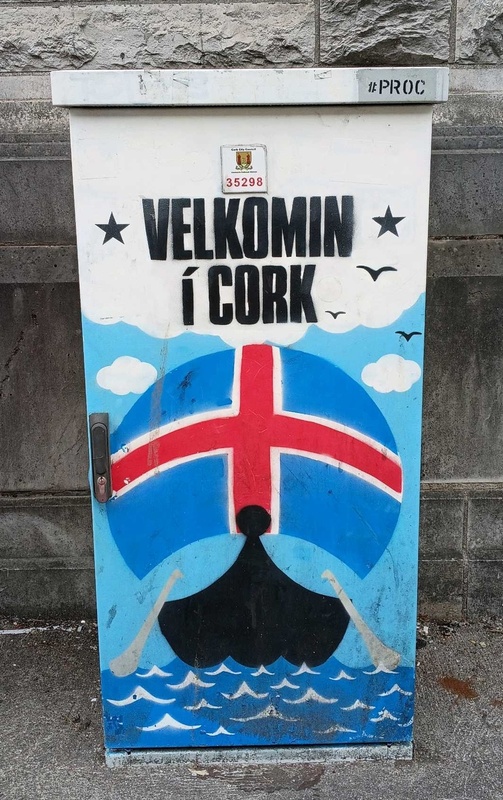
Street art welcoming people to Cork in Icelandic by Garreth Joyce. It depicts a Viking ship with the Icelandic flag as its sail. The concept for this artwork was conceived when a direct flight between Cork and Reykjavík was established. The connection has since been withdrawn, but the artwork and its message remain. This is part of a broader street art initiative by the group The People's Republic of Cork.
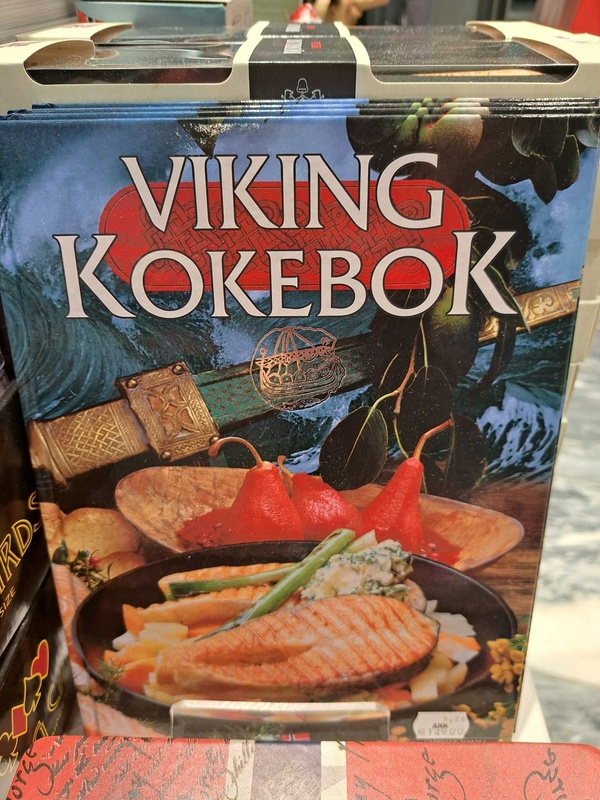
Picture of a cookbook reportedly about Viking food. The cover is a collage of what looks like traditional Norwegian food, a sword, a Viking ship, the sea, and Norse motifs.
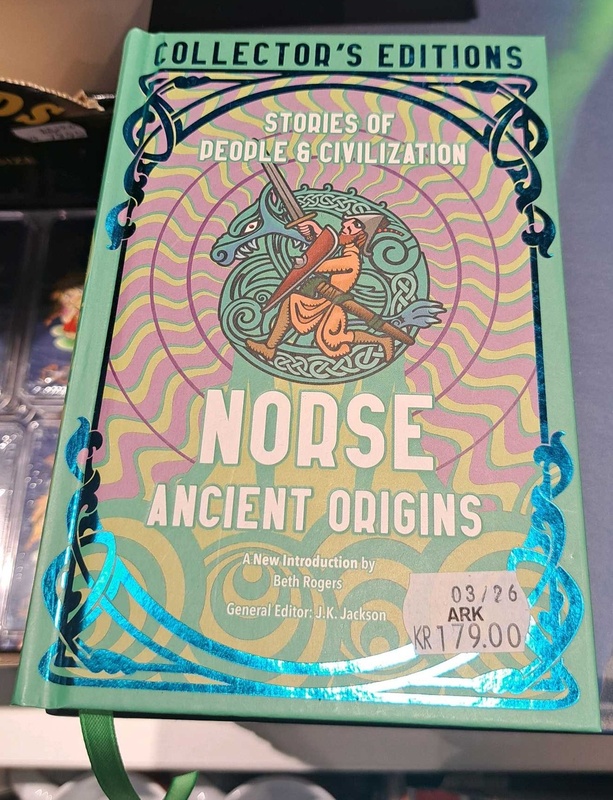
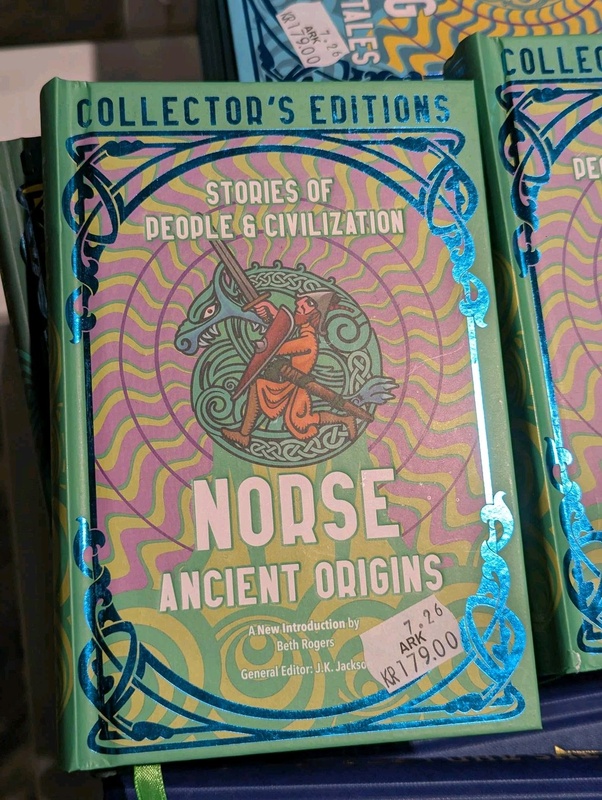
Book titled "Norse Ancient Origins", author unknown. The cover features a warrior in full kit stabbing upwards, behind him is a beast. This may be a nod to the legend of Sigurd killing the dragon Fafnir, as the iconology of this episode has Sigurd stabbing upwards into Fafnir's stomach.
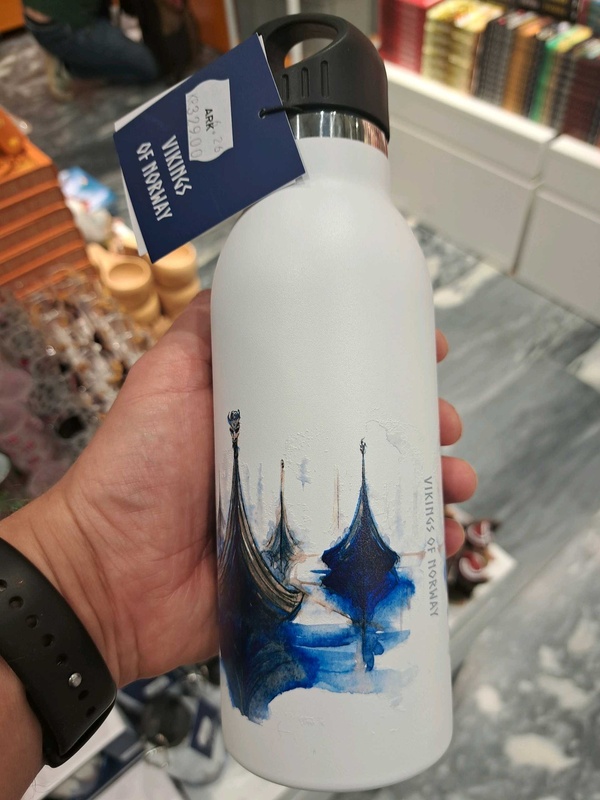
Water bottle decorated with several Viking ships. The artwork is in a style reminiscent of watercolours. The ships are painted from the front, and have decorative prow-heads.
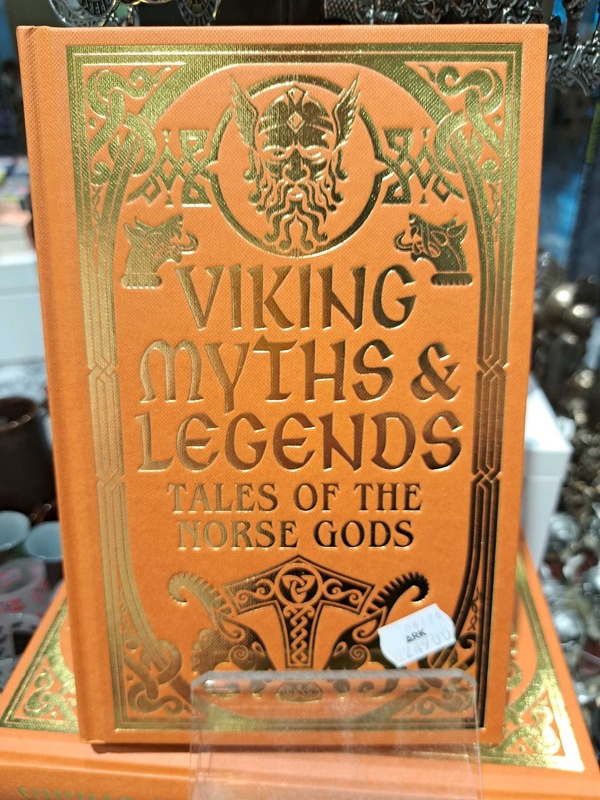
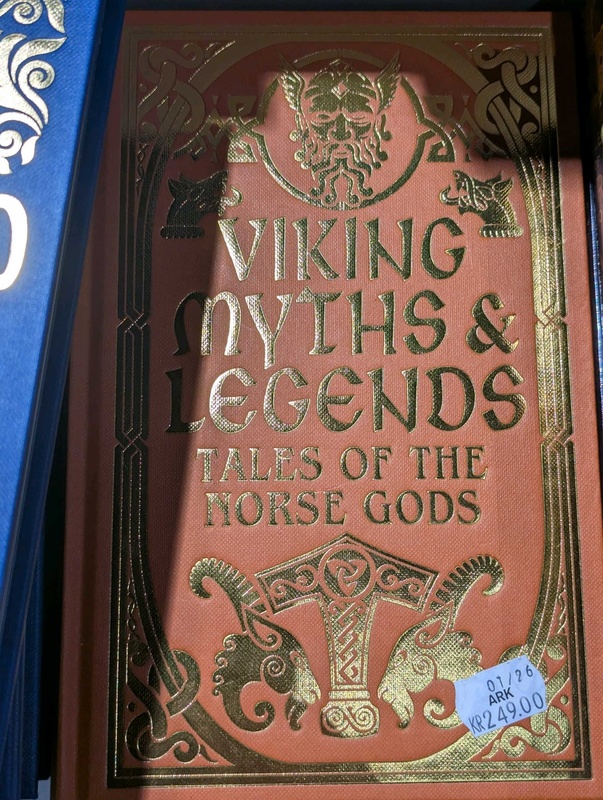
Picture of a book on "Viking Myths and Legends - Tales of the Norse Gods", by George Stephens and Rasmus B. Anderson. The title uses a font inspired by the uncial majuscule script, and the cover is decorated with Norse motifs. At the top, a depiction of Odin with a winged helmet, then two beasts, and at the bottom Thor's hammer Mjölnir flanked by Thor's goats.
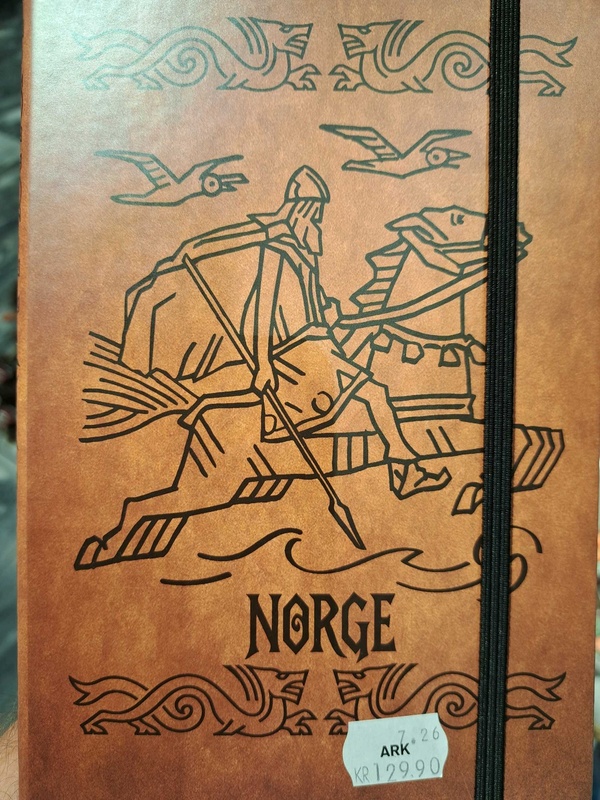
Notebook with a stylised depiction of Odin holding Gungnir while riding Sleipnir. Huginn and Muninn follow from the sky. The notebook also has decorative dragons on both top and bottom, and "Norge" (Norway) written in a runic inspired font. For sale at Oslo Gardarmoen airport.
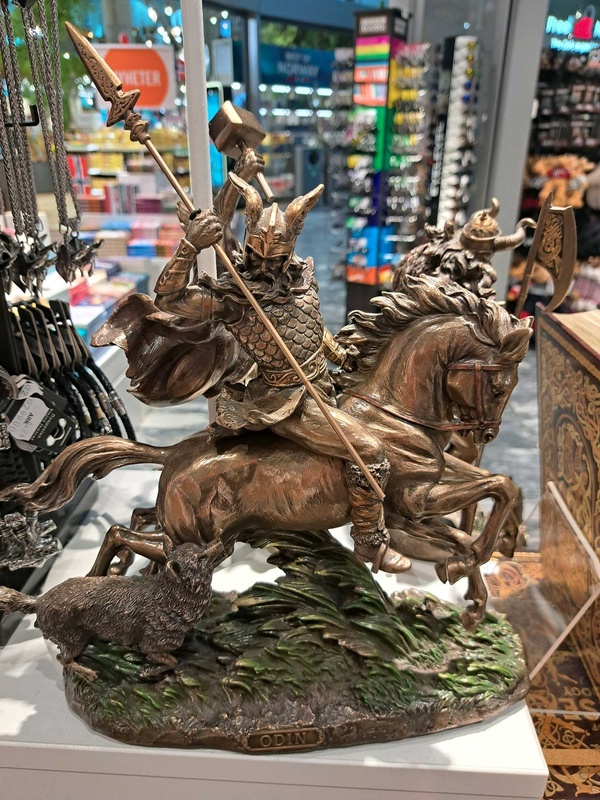
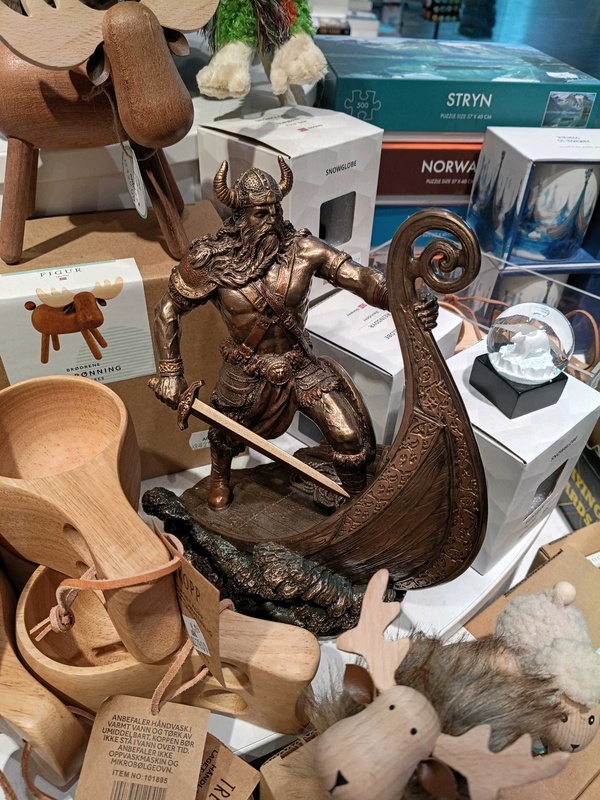
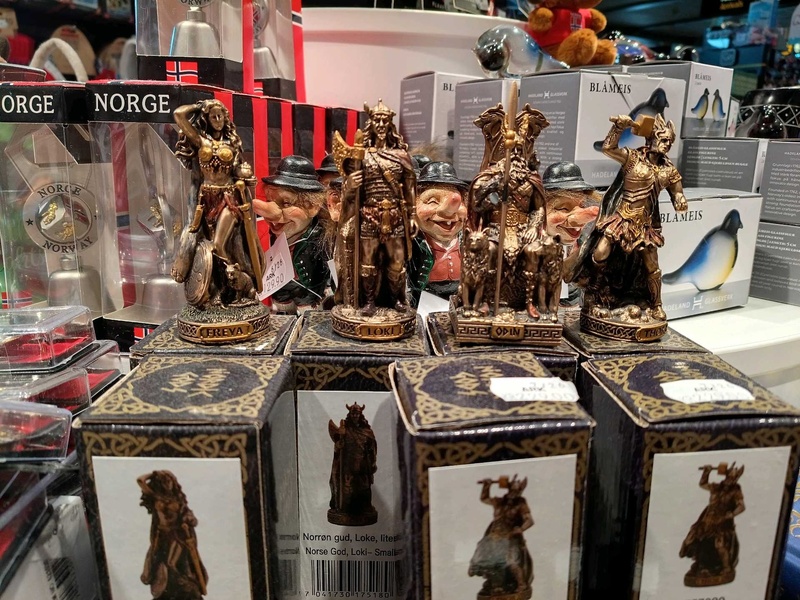
Bronze finish figurine of the Norse god Odin, for sale at Oslo Gardermoen airport. Odin has a winged helmet and is riding Sleipnir and holding the spear Gungnir, while a wolf follows him.
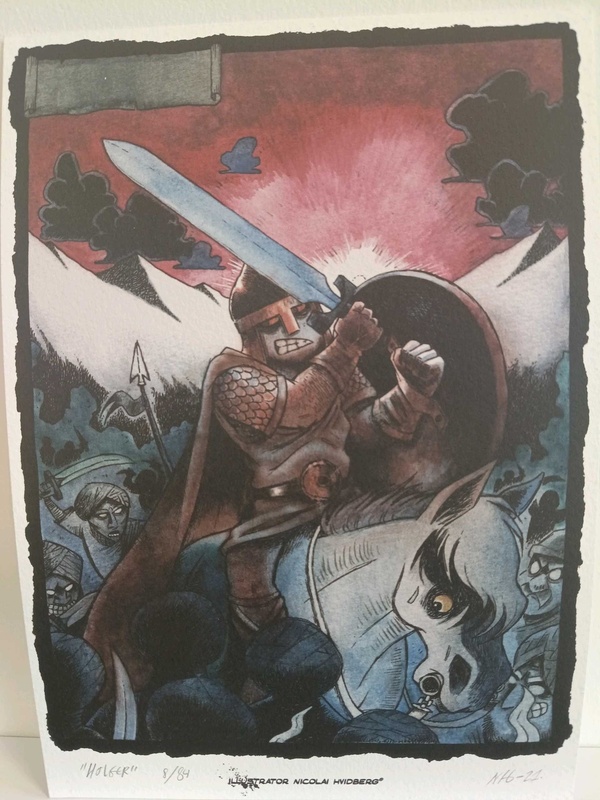
Art print of Holger Danske by Nicolai Hvidberg. It depicts the fabled Danish warrior Holger fighting against a hoard of Saracen warriors while under the service of Charlemagne. Holger is on a horse, in full kit, holding a sword and shield.
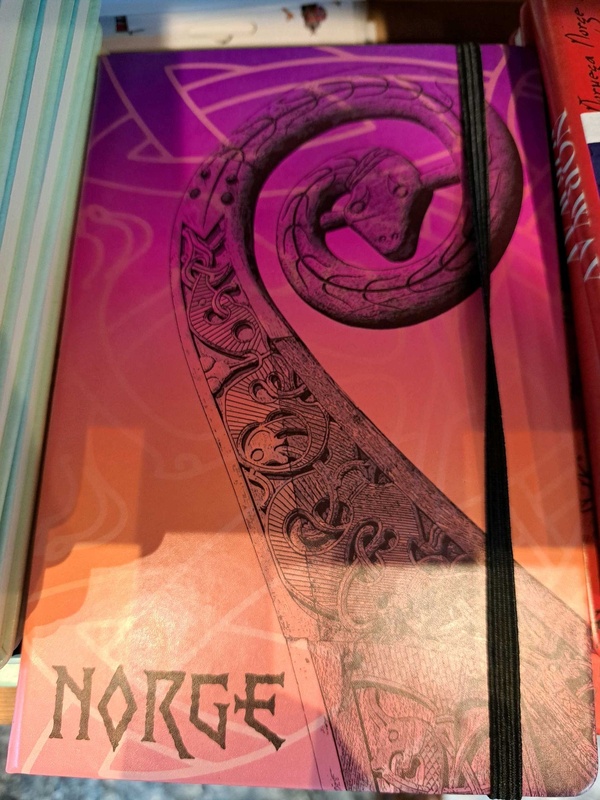
The cover of this notebook reads "Norge" (Norway) in a font inspired by runes, and depicts the ornate snake prow from theViking ship found in a burial in Oseberg in 1904.
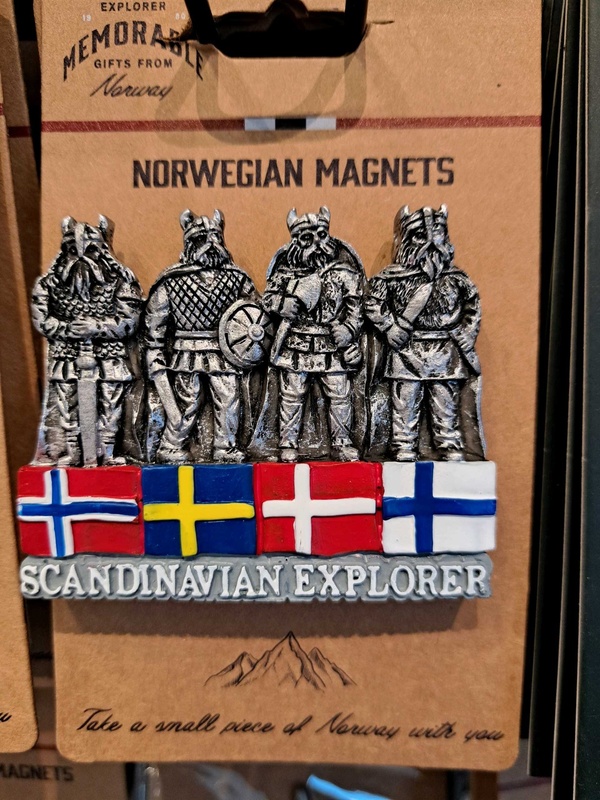
Magnet for sale at Oslo Gardermoen airport depicting four vikings in full kit and horned helmets. Each of them is depicted atop one of four flags: Norwegian, Swedish, Danish and Finnish.
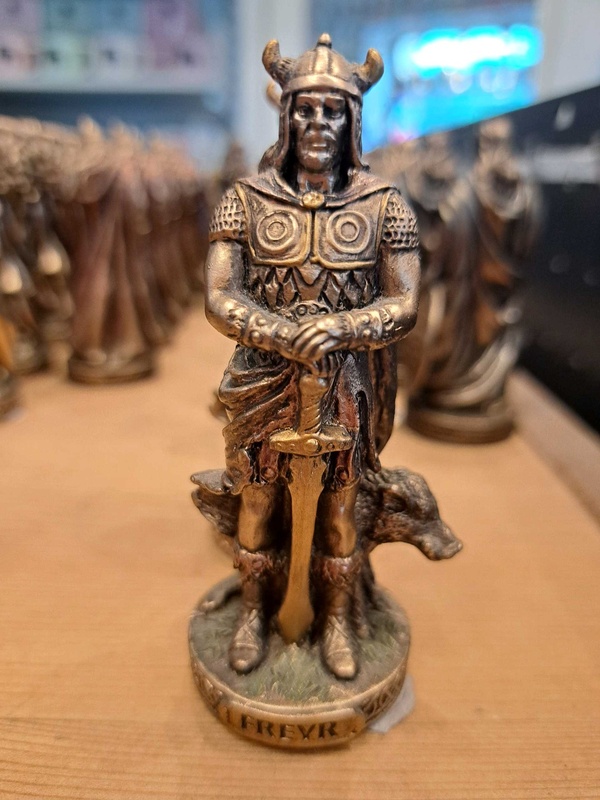
Bronze finish figurine of Freyr, Norse god associated with kingship, fertility, peace, prosperity, fair weather, and good harvest. Depicts Freyr with a horned helmet, armour, sword and the boar Gullinbursti. For sale at Gardemoen Airport.
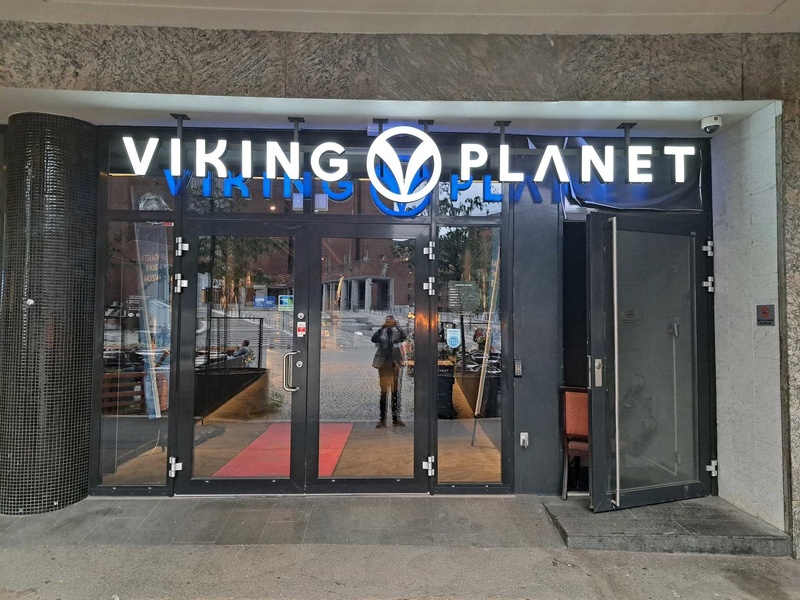
Entrance to the Viking Planet digital museum in Oslo. This museum offers visitor the chance to interact with the Viking Age in a varieties of way: there are holograms, 3D artefacts, interactive screens and a VR experience.
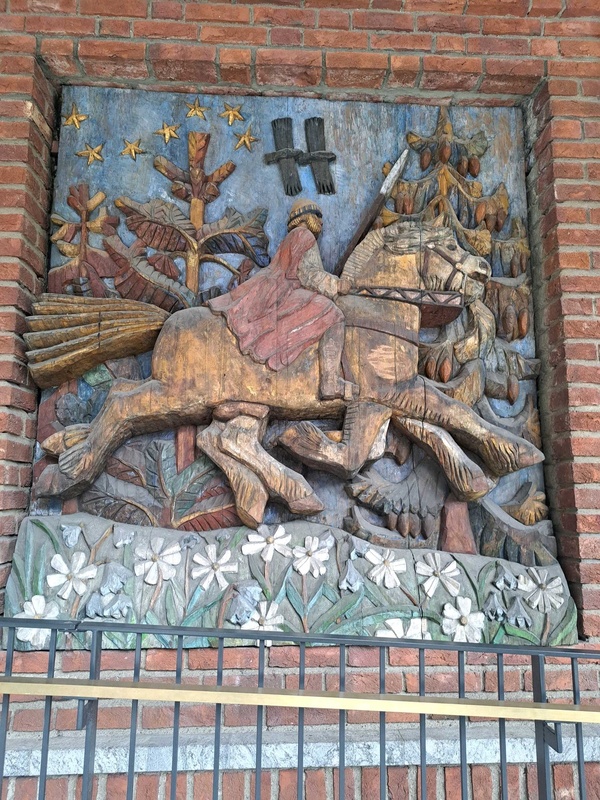
One of a series of wooden reliefs on the outside of Oslo Rådhuset (City Hall) - the Yggdrasilfrisen - produced by Norwegian artist Dagfin Werenskiold in 1950.
"Don’t Be a Viking" campaign video humorously illustrates the patient journey for someone with Dupuytren’s contracture (also known as "Viking hand") to encourage early medical consultation and nonsurgical treatment.
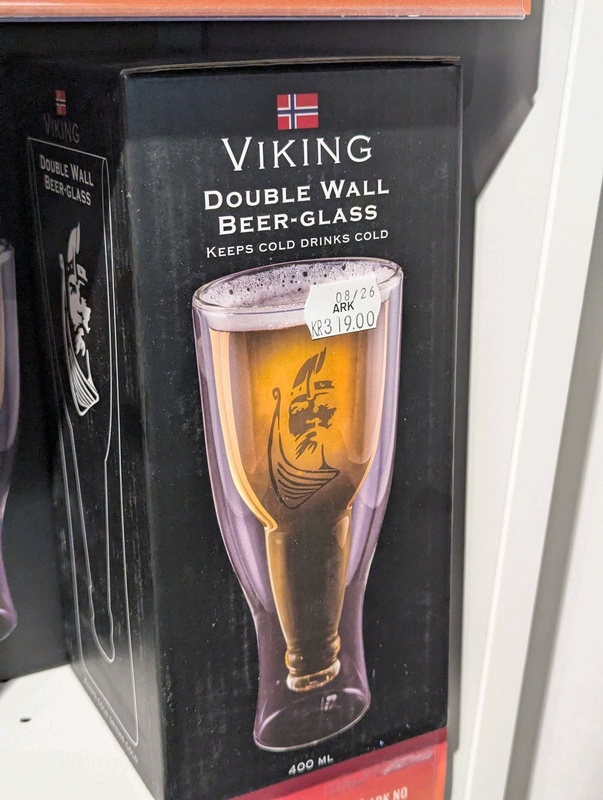
Viking branded Double Wall Beer Glass (400 ml), featuring an insulated double-walled design with an inner chamber shaped like an upside-down beer bottle and a Viking graphic.
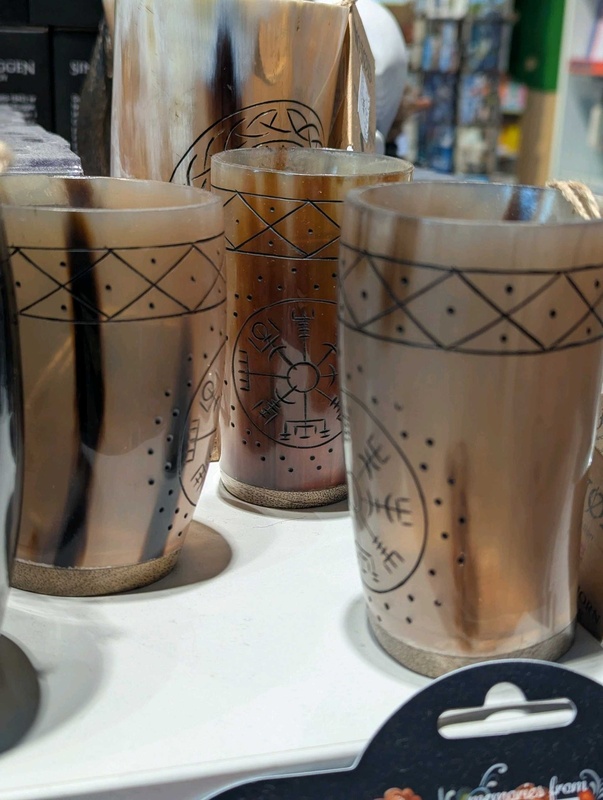
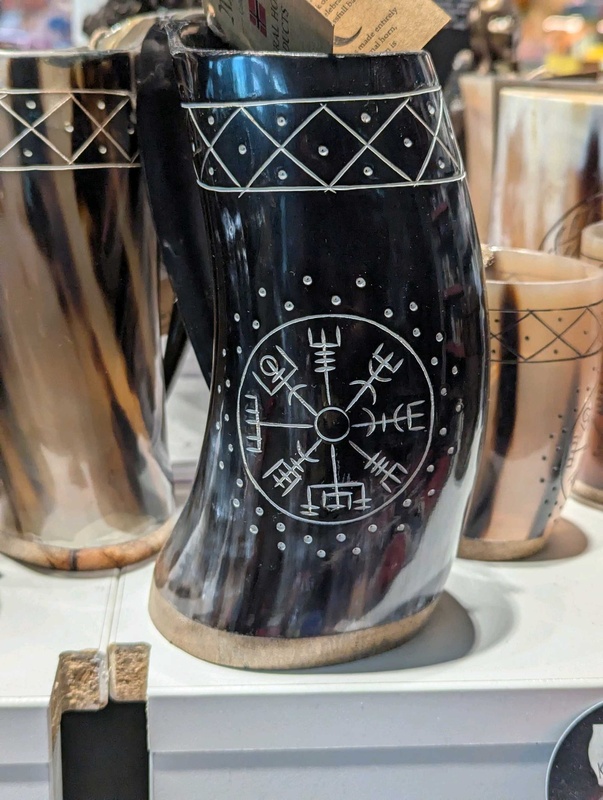
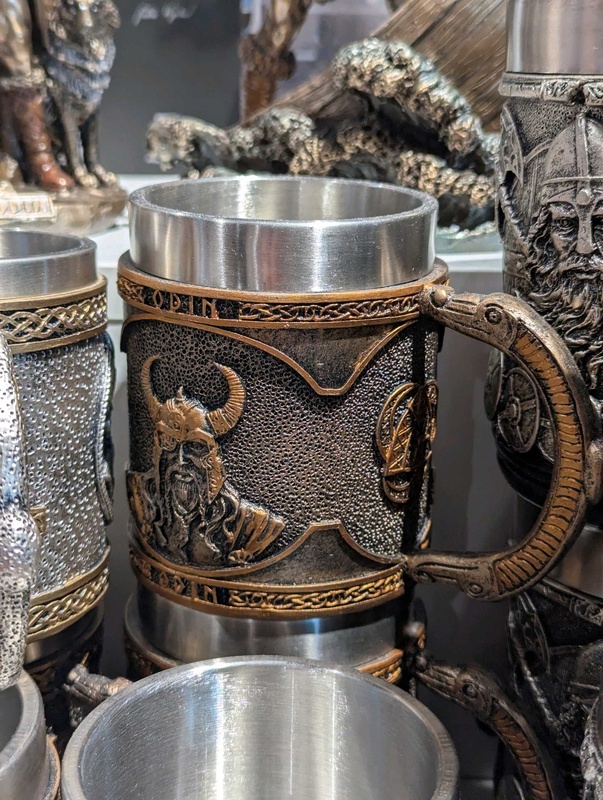
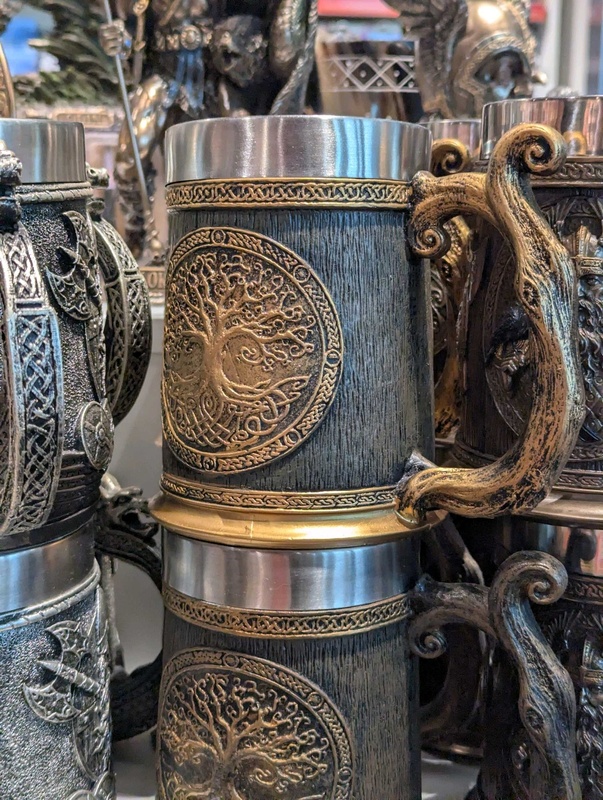
A tankard featuring Yggdrasil, the World Tree, as the central motif. The design draws on imagery from Norse mythology, with detailed branches and roots representing the tree that connects the Nine Worlds. The handle is shaped as a tree branch.
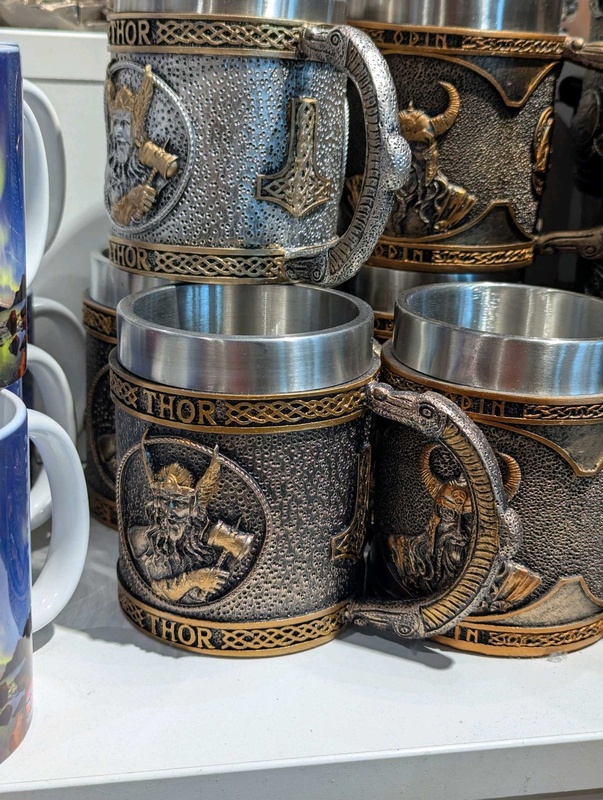
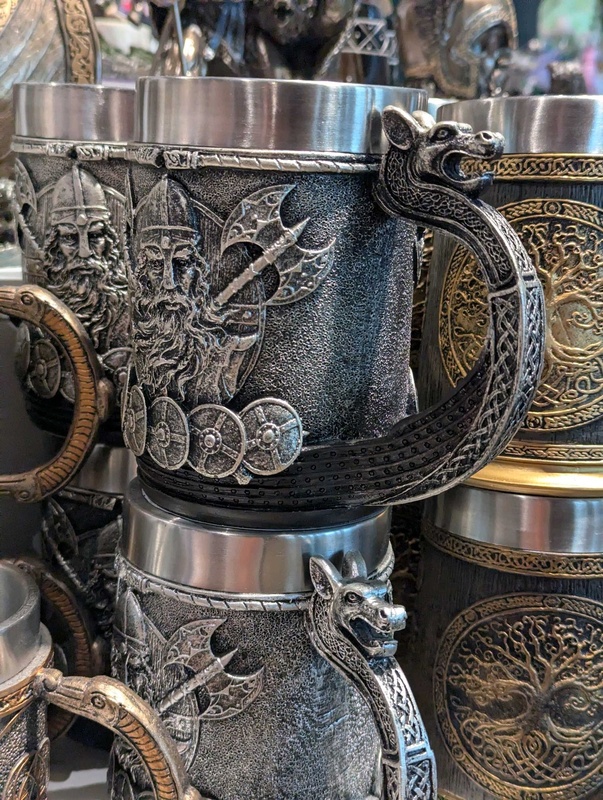
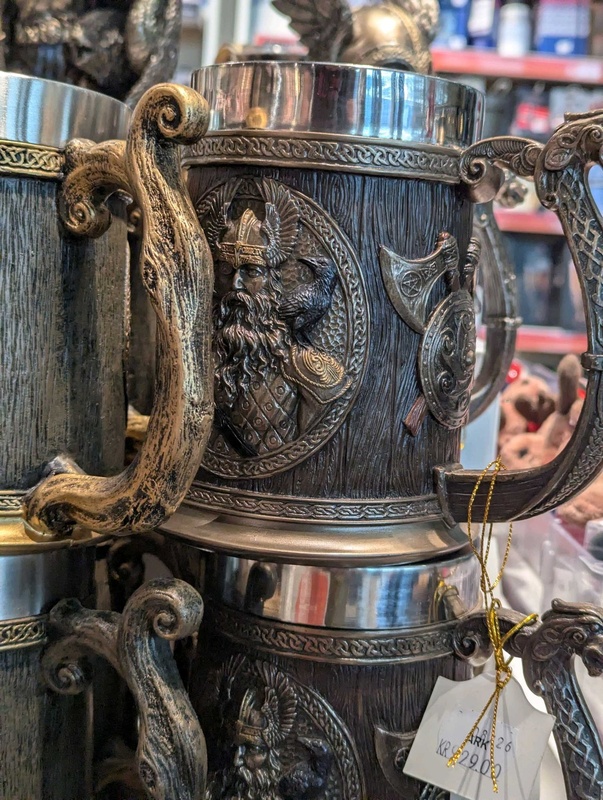
A wooden-style tankard featuring a bas-relief of Odin with the ravens Hugin and Munin resting on his shoulders. The design includes a dragon-shaped handle and a shield decorated with two crossed axes, drawing on motifs commonly associated with Norse mythology and Viking art.
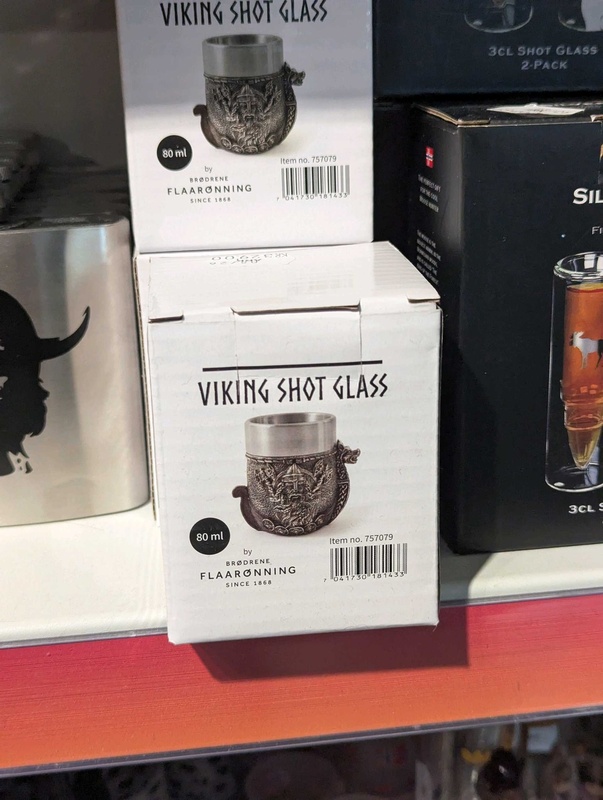
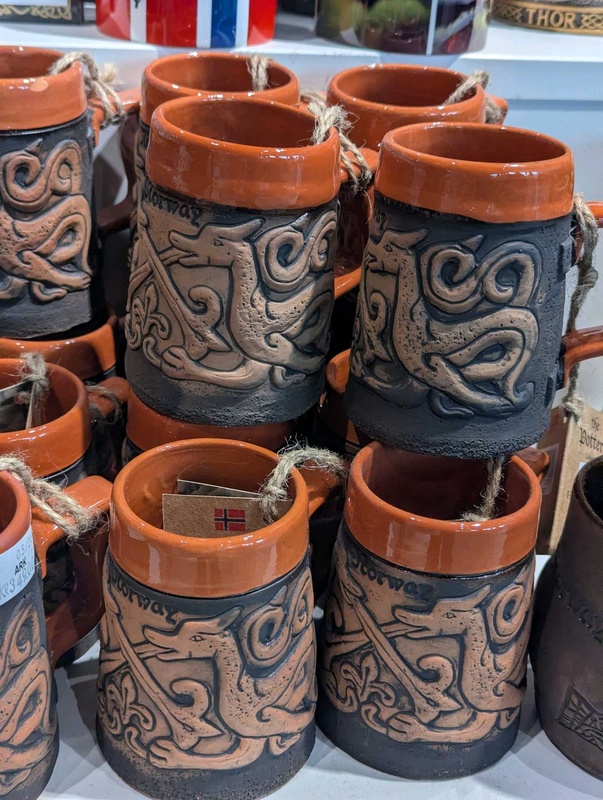
Handcrafted ceramic Viking dragon mug from Brødrene Flaarønning's "The Pottery" Norway collection. Made from natural clay featuring textured, dark-textured body reliefs of a traditional Viking dragon/serpent motif and a glossy orange-brown glazed rim and interior.
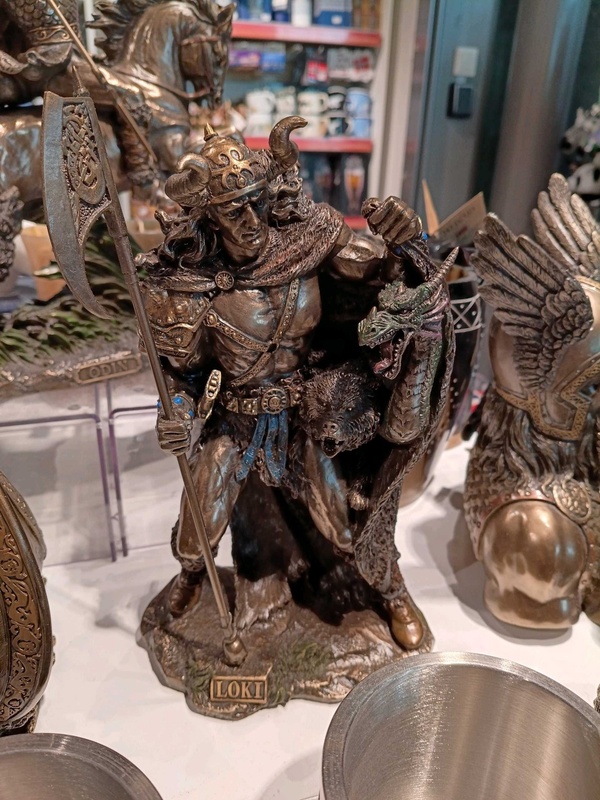
Bronze finish figurine of Loki, the Norse god of mischief and trickery. Depicts Loki with horned helmet, holding a long axe and spear, draped in a cloak with a wolf and serpent motifs. For sale at Gardemoen Airport.
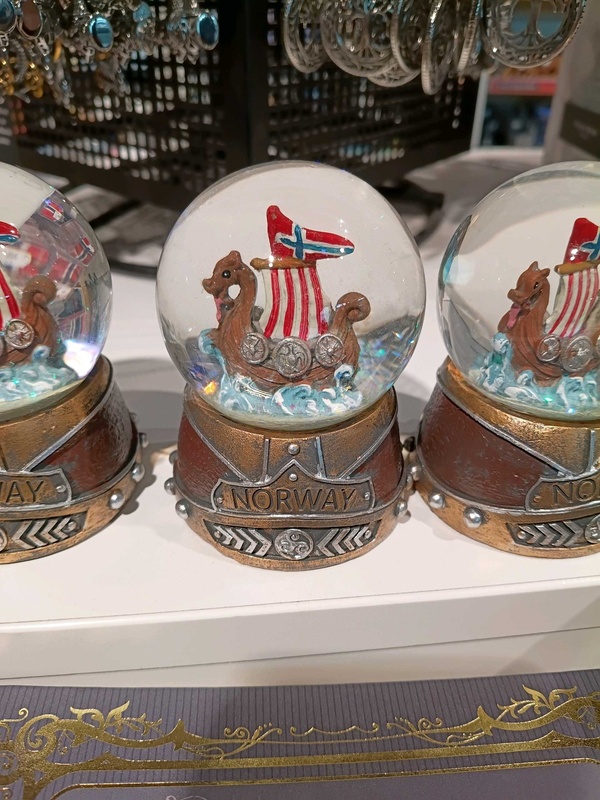
Snow globe featuring a possibly hand-painted resin Viking longship with a red-and-white striped sail, a Norwegian flag, and an embossed base labeled "Norway". For sale at Gardemoean airport.
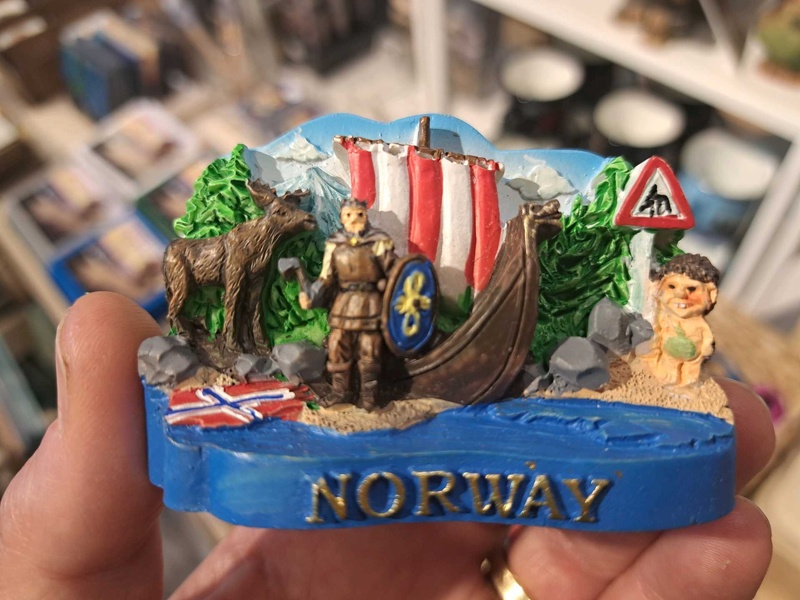
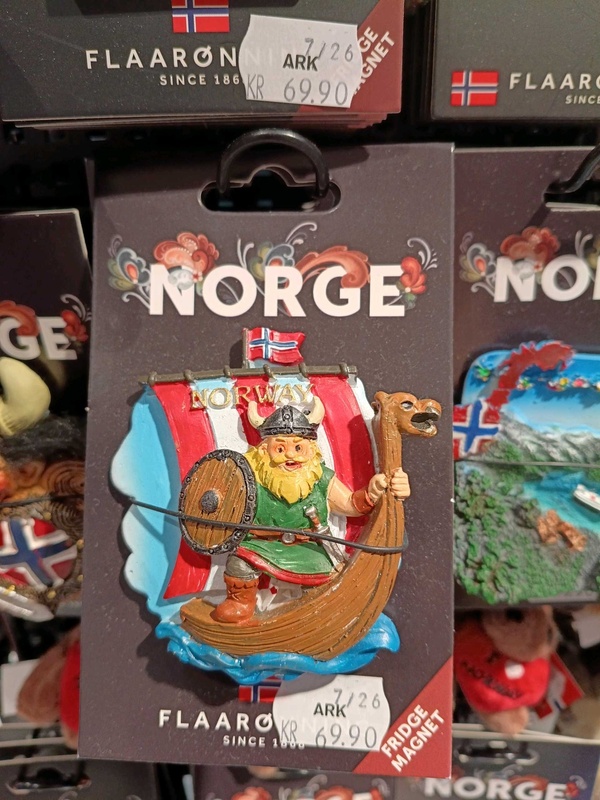
Norway souvenir fridge magnet features a cartoon-style horned Viking in a traditional longship decorated with the Norwegian flag and "Norge" written at the top. For sale at Gardemoen Airport.
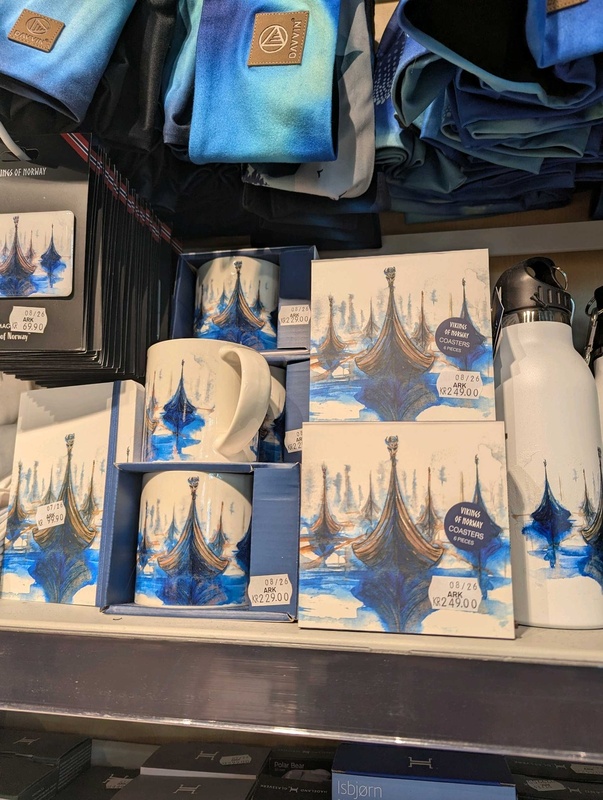
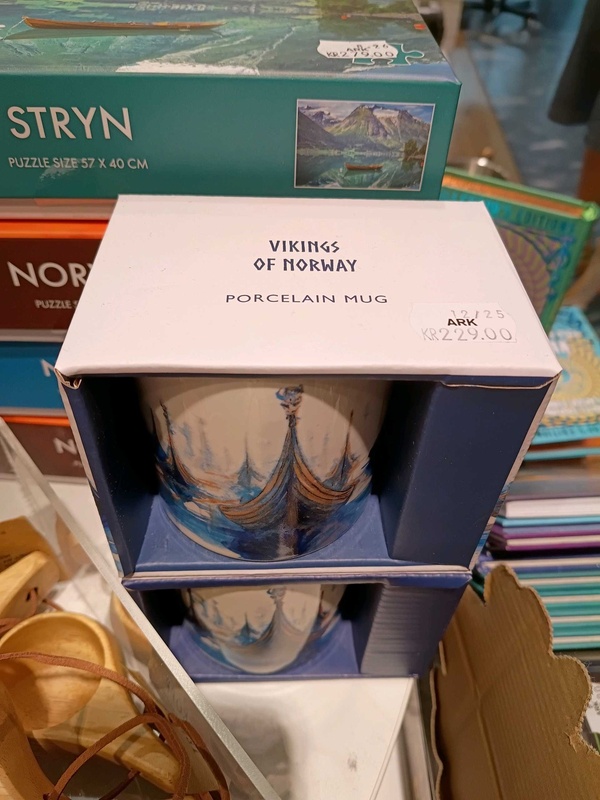
The Vikings of Norway porcelain mug features an artistic illustration of traditional Viking longships navigating blue and white ocean waves. For sale at Gardemoen airport.
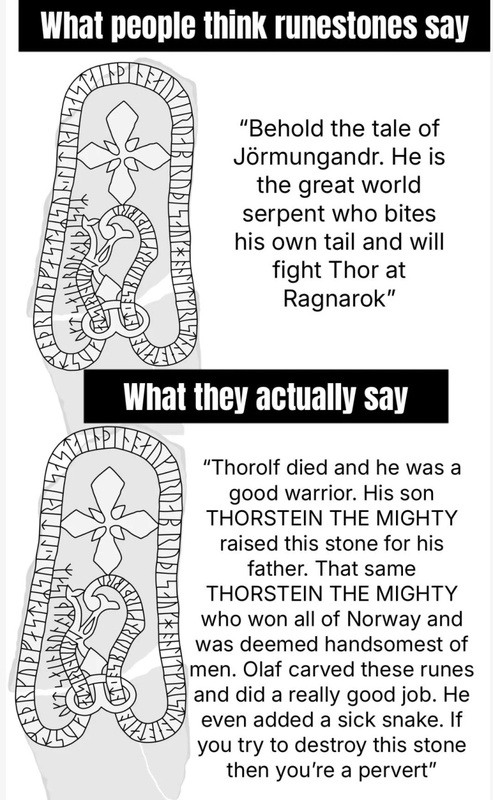
This meme shows that while people expect ancient Viking runestones to tell epic mythological stories about gods and monsters, they mostly just contain ordinary, vain, or funny everyday messages.
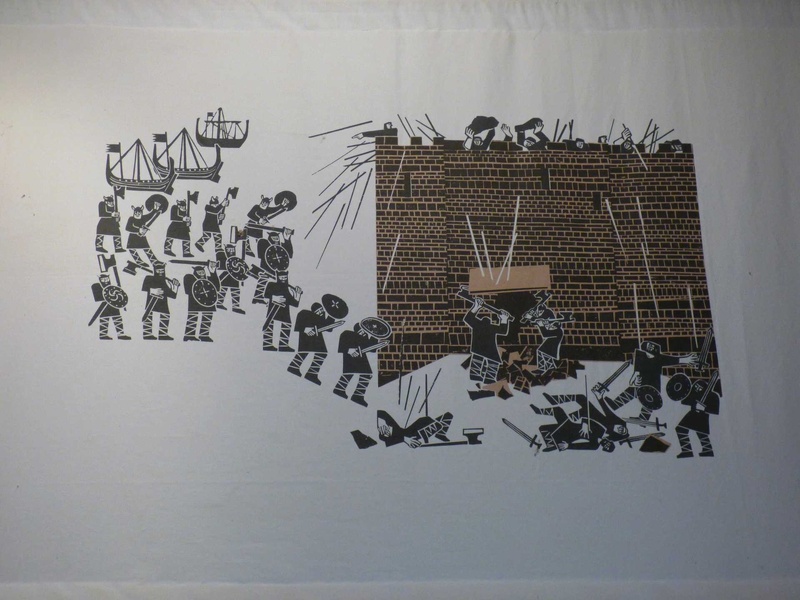
Artwork depicting the Norwegian attack on Rothesay castle in 1230, where the Norwegians managed to hew part of the wall away with their battle axes. Displayed in Rothesay castle itself as part of a series showing the castles history.
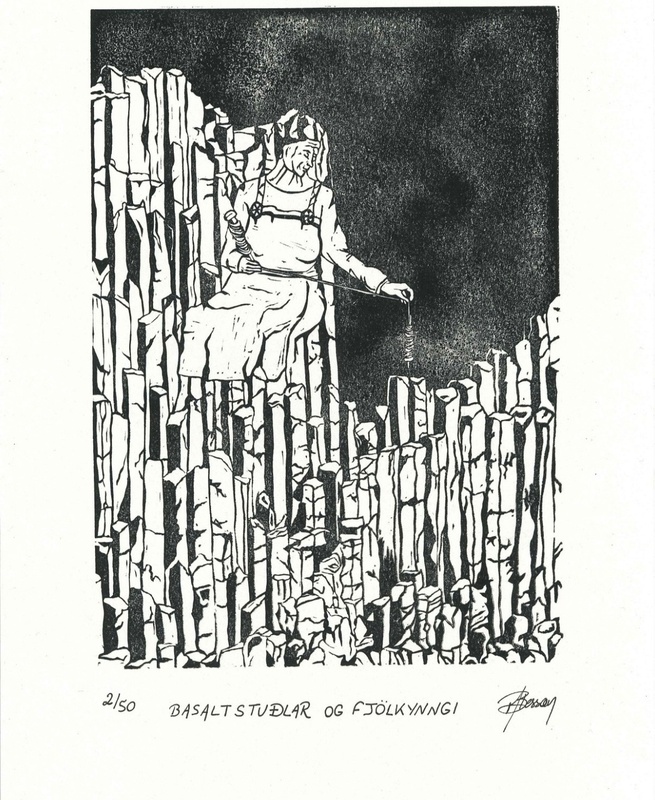
Basaltstuðlar og fjölkynngi (basalt columns and sorcery). Created by Marie Sophie Besson (https://www.instagram.com/marie.giboulee.art/) using linocut printmaking technique. The integration of Iceland's natural landscape with a figure apparently practising seiðr suggests a connection to broader Viking heritage. References to seiðr are common in saga and eddic literature, often focusing on its practice by both appropriate and controversial figures.
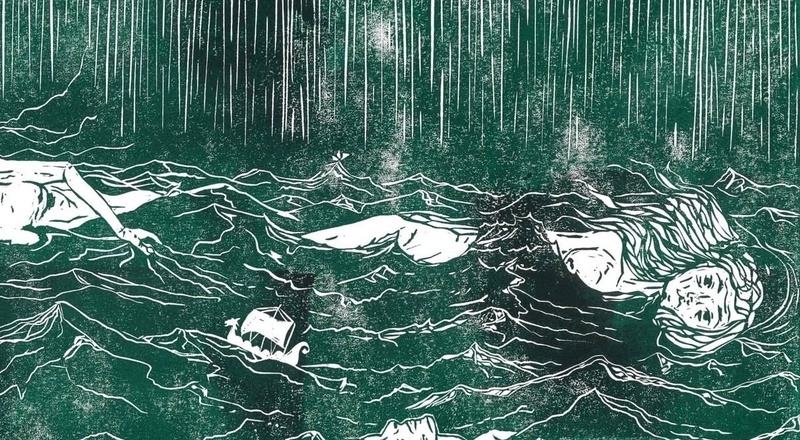
Svalar unnir, dætur Ránar (black waves, daughters of Rán) . Created by Marie Sophie Besson (https://www.instagram.com/marie.giboulee.art/) using linocut printmaking technique. In Norse mythology, the Daughters of Seagoddess Rán (also known as the daughters of Ægir) are nine personifications of sea waves.
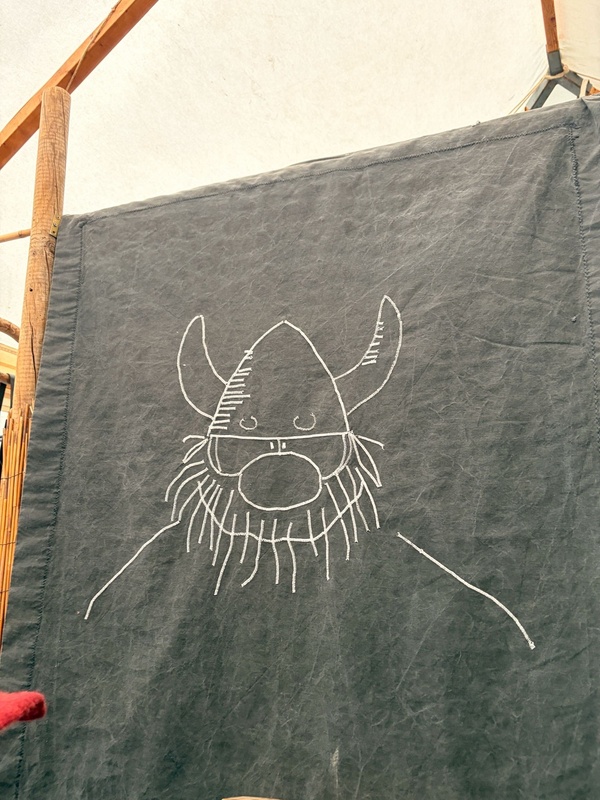
A white line-art embroidery or print of a stylized cartoon Viking depicted on a textured dark gray, fabric-like canvas background. The Viking is Hägar the Horrible, main character of the eponymous comic strips created by Dik Browne and launched in 1973. Seen at the Schlosshof Festival 2026 (https://www.schlosshof-festival.de/Startseite.html).
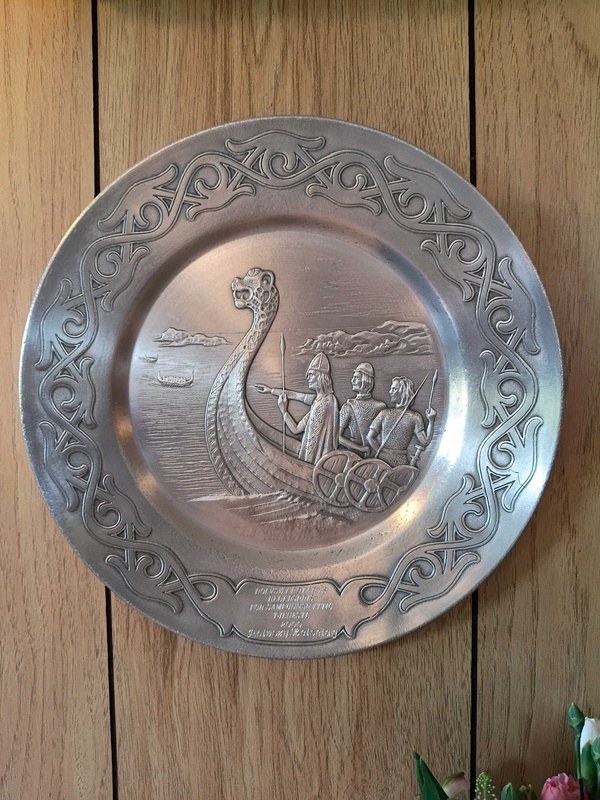
Decorative, circular pewter plate featuring a detailed relief engraving of a Viking longship and Norse warriors. The border contains a wide, continuous band of traditional Celtic or Norse knotwork loops around the rim.
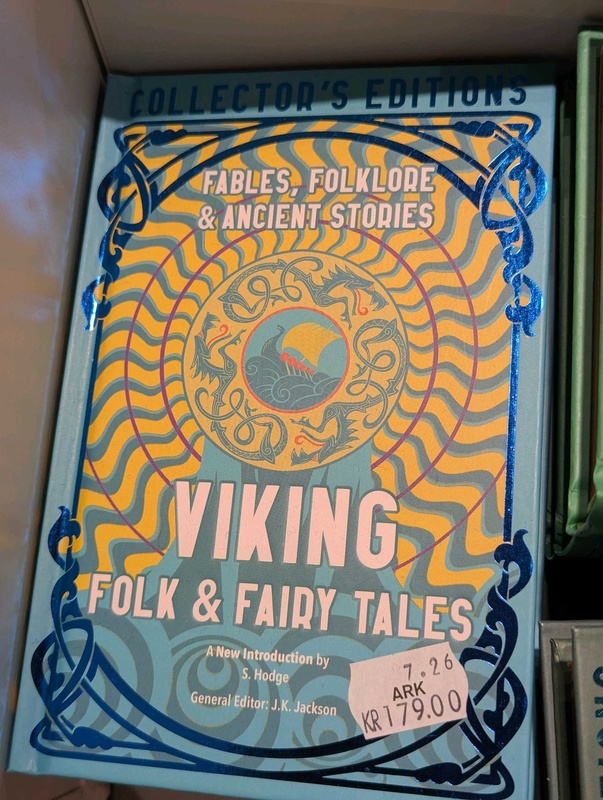
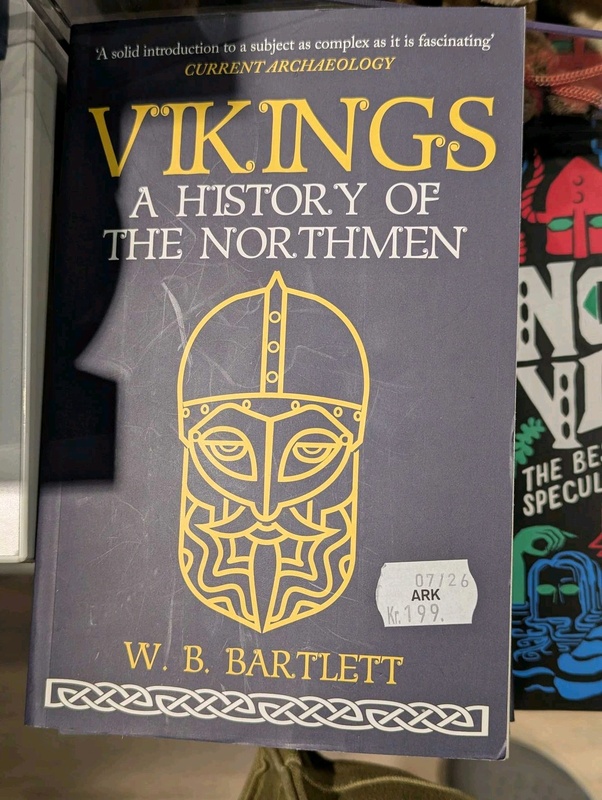
Vikings: A History of the Northmen by W. B. Bartlett (2019), a history of the Vikings, exploring their society, warfare, exploration and expansion across Europe and the wider medieval world.
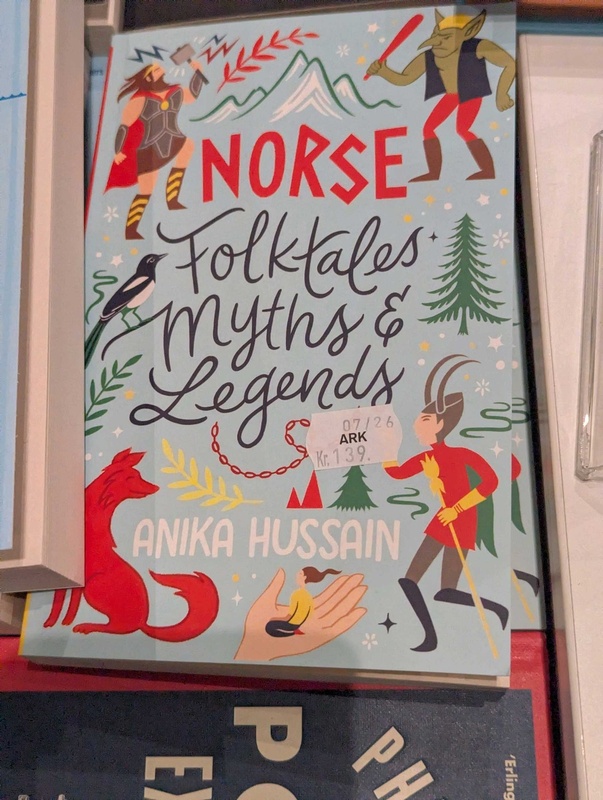
Norse Folktales, Myths & Legends by Anika Hussain (2022), an illustrated collection of traditional Norse folktales, myths and legends, introducing stories of gods, mythical beings and heroes from Norse tradition.
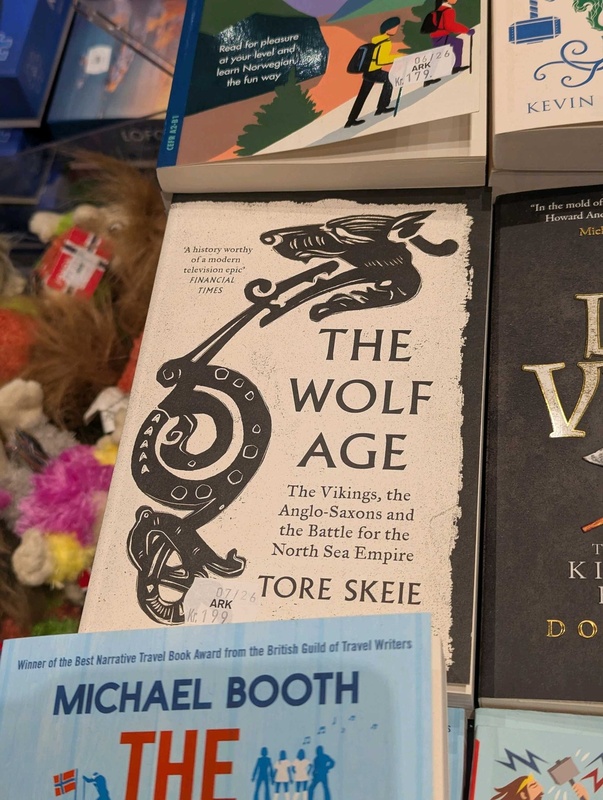
The Wolf Age: The Vikings, the Anglo-Saxons and the Battle for the North Sea Empire by Tore Skeie, a history of the struggle between Vikings and Anglo-Saxons for control of the North Sea world, focusing on the rulers, warriors and conflicts that shaped the eleventh century.
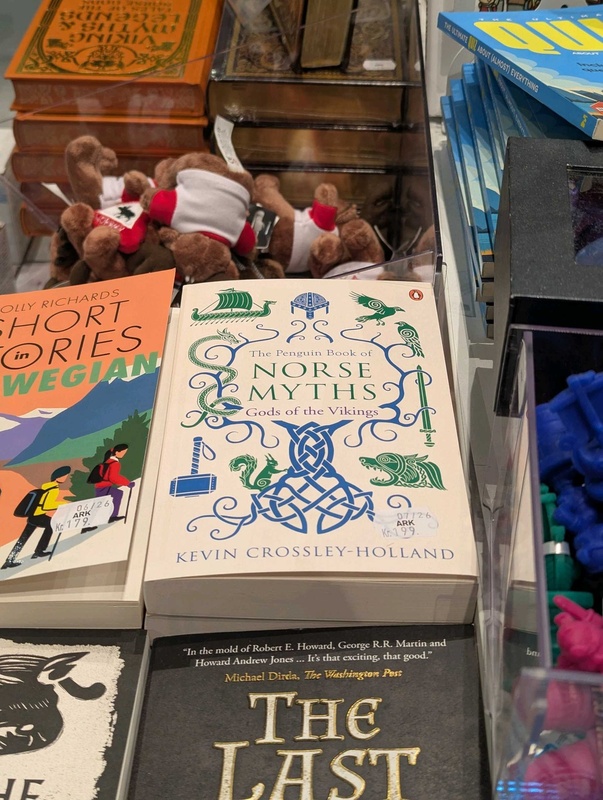
The Penguin Book of Norse Myths: Gods of the Vikings by Kevin Crossley-Holland, a collection and retelling of Norse myths, featuring stories of gods, giants, heroes and other figures from Norse mythology, originally published in 1980.
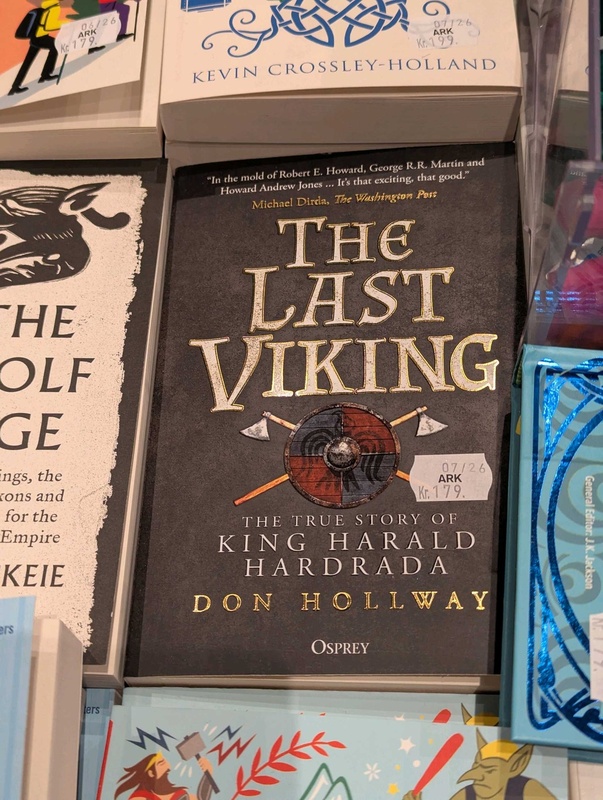
The Last Viking: The True Story of King Harald Hardrada (2021) by Don Hollway, a biography of Harald Hardrada, King of Norway and one of the most renowned Viking warriors, displayed among Norse and Viking-themed books.
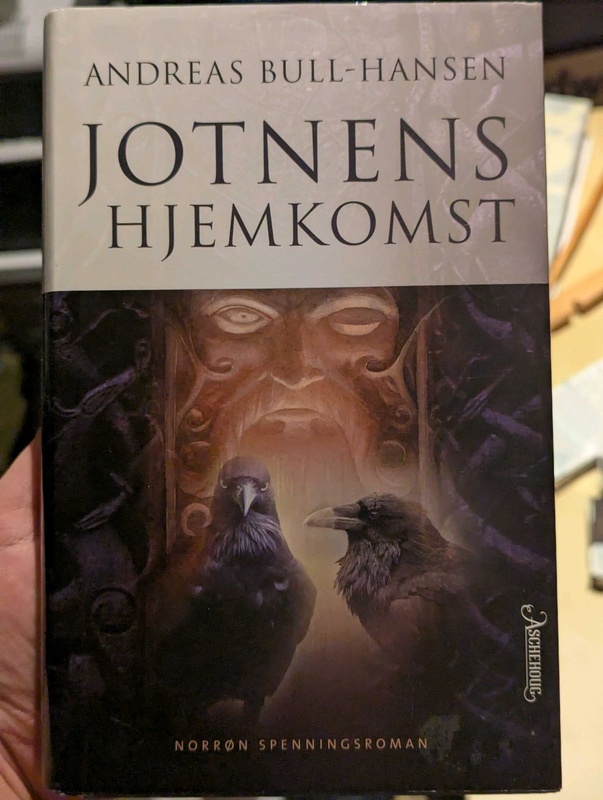
Jotnens hjemkomst (Return of the Giant), the first installment in the Tyr Trilogy (Tyr-trilogien) written by Norwegian author Bjørn Andreas Bull-Hansen.
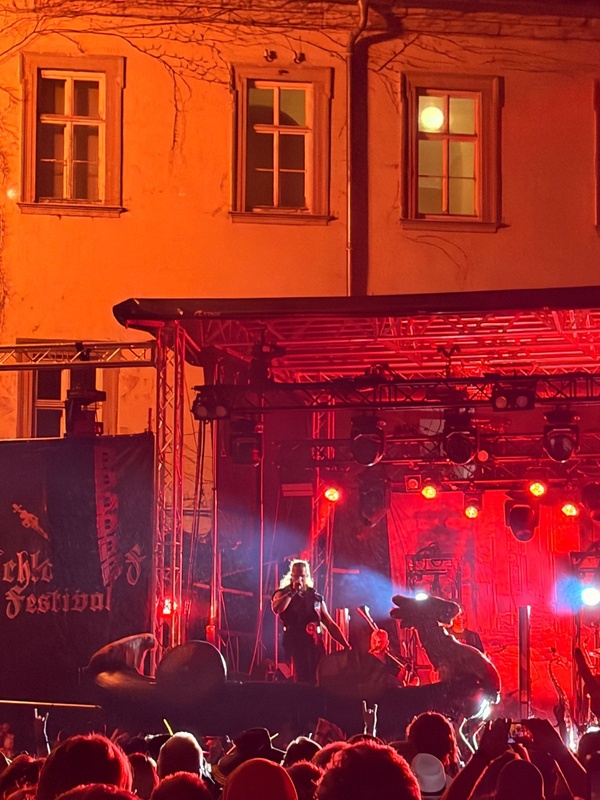
Saltatio Mortis performed on a large replica of a Viking longship at the Schlosshof Festival 2026. Saltatio Mortis primarily performs medieval metal, medieval rock, and folk rock.
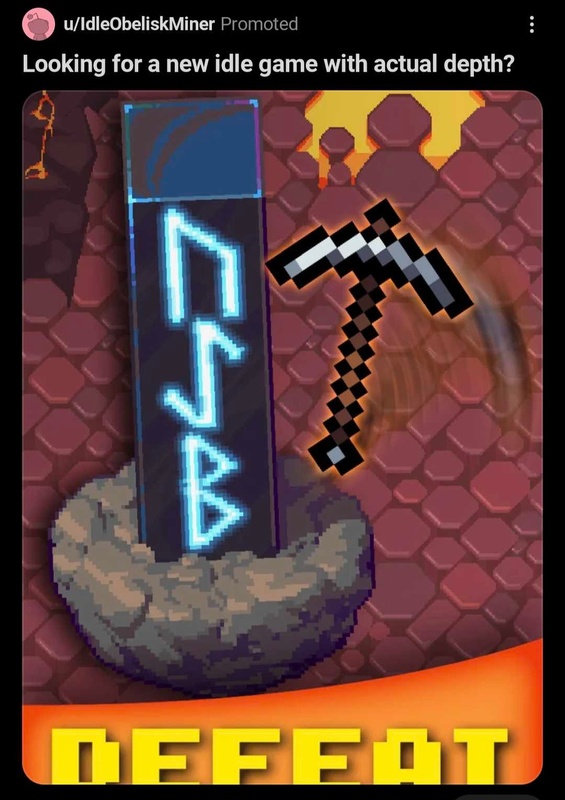
Idle Obelisk Miner is an incremental mining simulator developed by Checkbox Entertainment. The picture is a screenshot from the game featuring a pick axe and a sign with runes saying "USB".
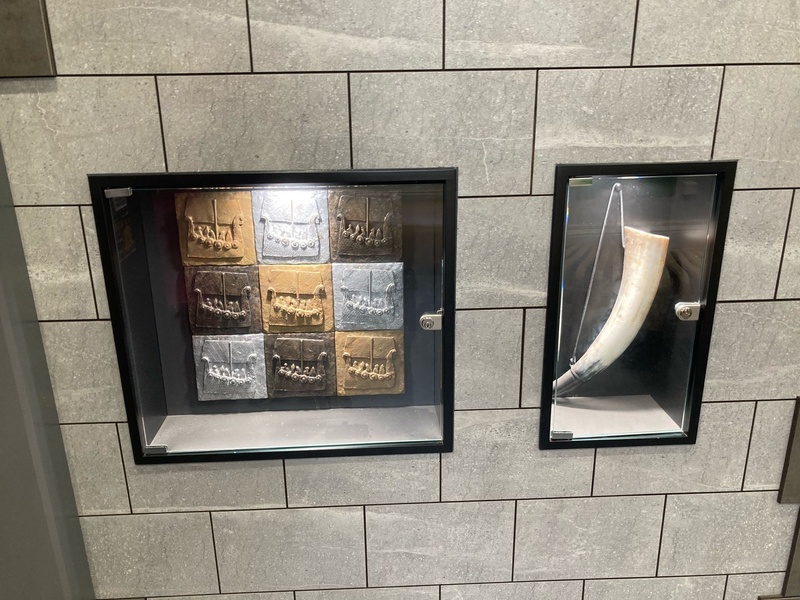
Viking artefacts on display at the York station including nine small, metallic Viking ship relief tiles mounted in a grid formation on a textured wall and a replica drinking horn.
Norwegian soccer fan Emil Anners Lappen tells CBC The National about the moment he got caught on camera refusing to join a ‘factually wrong’ celebratory Viking row in Gjøvik after Norway’s win over Senegal at the 2026 FIFA World Cup.
Visit Haukeli is a tourism website which includes tourism attractions that have a Norse influence. One of them is the Urdbøuri and Uravert where the website says "Uravert is considered to be quite mysterious, the valley is too wide and the surrounding mountains too low to be able to give such a result. Therefore, there are several legends about Urdbøuri. The only victory was won by Thor with the hammer who hit the mountain in anger. He became furious when he was not offered more beer at a wedding on a farm that was located here. The masses of stones fell down on the people and the farm, but then the hammer slipped out of his hand and disappeared into the stone rubble. Thor then went through the rubble and threw stones aside through the rubble to find his hammer again, and that is how Thor's Way was created".
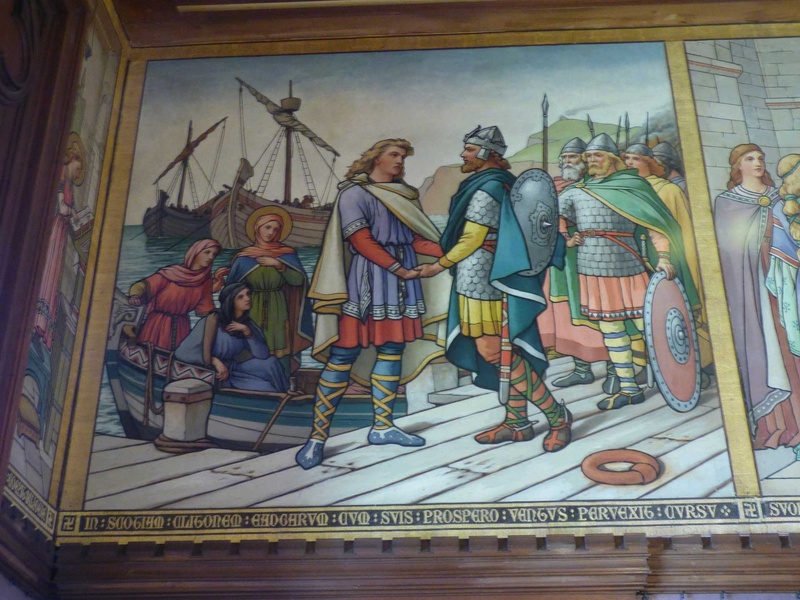
Depiction of King Edgar of Scotland and the Norse King Magnus Barefoot, to whom he ceded the Hebrides and Kintyre. The Latin underneath says that Edgar sailed back to Scotland with favourable wind.
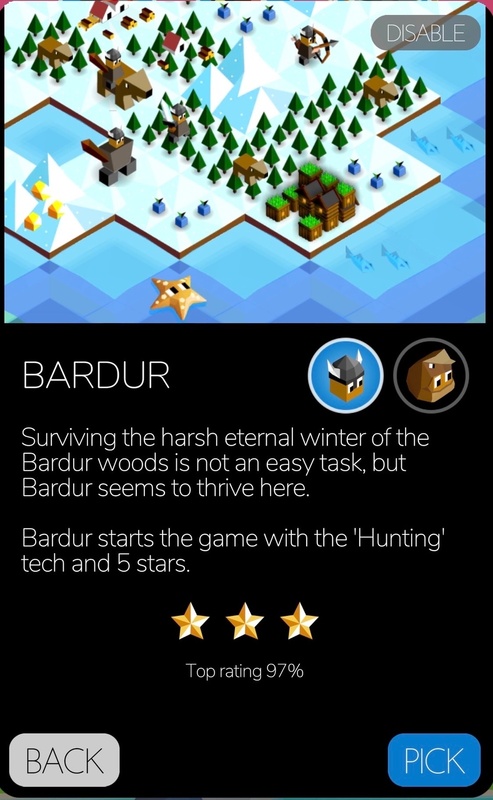
A game character selection screen for the Bardur tribe in The Battle of Polytopia. The illustration shows stylised characters wearing Viking-inspired horned helmets in a snowy landscape with forests, villages, and wildlife.